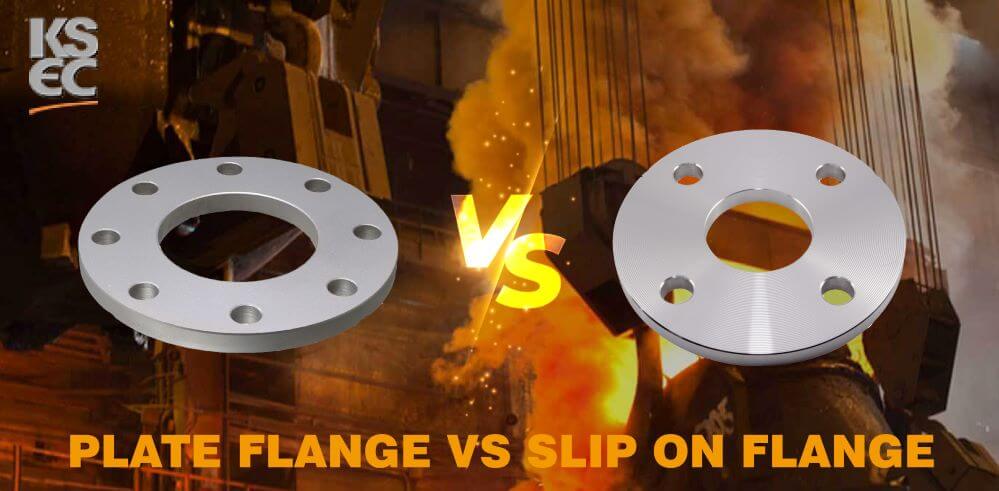
There are many different types of flanges available in the market. For instance, weld neck flanges, slip-on flanges, butt weld flanges, plate flanges, and blind flanges, and so on. Today, in this blog, we shall understand two of the flanges types – plate flange and slip-on flange.
What are Plate flanges?
A plate flange is a flat, circular disc welded to a pipe’s end enabling the flange to be bolted to another pipe. It is often referred to as flat flange, plain flange and flange slip, etc. Two plate flanges can be bolted together with a gasket in between them, usually used in fuel and water pipelines.
The length of the pipes is not always known while constructing a pipeline. The plates may also be welded with a slight bias to the shaft, allowing two pipes that might not be perfectly matched up to be joined.
Plate flanges have a serrated finish on the inner mating surface allowing the plate to fit within the material of the gasket. In any given dimension, plate flange designs are standardized regardless of the materials used to manufacture them. This ensures it exactly fit a 6-inch (15 cm) black pipe flange to a 6-inch stainless steel flange. This guarantees a perfect seal between the two connecting pipes.
What are Slip-on flanges?
Slip-On flanges also known as SO flanges, or reducers, long-tangent elbows, and swags are built to slip over the outside of the pipe. The flange has low vibration and shock resistance. Aligning a slip-on flange is simpler than any other flange. The slip-on flange is suitable for applications with low pressure as the strength is around one third that of a weld neck flange when under internal pressure. The Slip-on flange features an elevated profile.
Slip flanges or SO flanges are typically lower in cost hence making a common choice for the customers. A fillet weld is often welded to the back or exterior of the slip-on flange or SO flange. Because of their lower initial cost, they are favored over other flanges by many consumers, but the final installation cost is possibly not much less than that of the other flanges due to the additional welding involved.