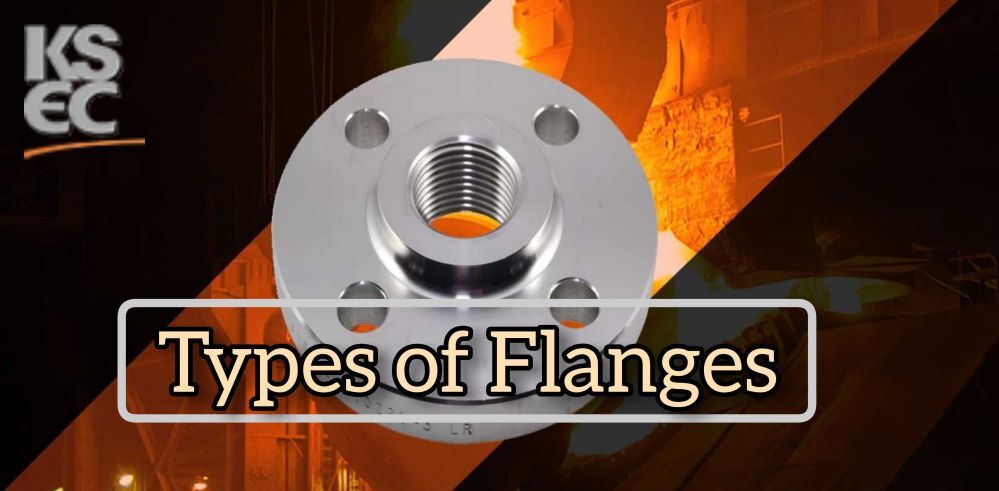
Flange is a way to form a piping structure by connecting pipes, valves, pumps and other equipment. For cleaning, inspection or modification, it also provides convenient access. Flanges are available in many types like:
-
Slip-On Flange
The flange is slid over the pipe and welded to the top and bottom of the flange. They are used to provide the connection with sufficient strength and to stop leakage. This flange is preferred over welded neck flanges as less precision is required when cutting the pipe to length, the cost of production is lower, but the result is almost the same.
-
Blind Flanges
This is a flange with no bore. Often called a blanking flange, it can be used to fix or seal the end of the pipe frame or to shut off the pipe system or the opening of the vessel. The inspection of vessels or pipe structures is faster and easier to access. Based on the requirements, a blind flange may be supplied with or without a hub.
-
Lap-Joint Flanges
Lap-Joint Flanges are the same as a slip-on flange, except at the intersection of the bore and the flange face it has a radius to match the end of the lap stub. The gasket face on the flange is formed by the face on the end of the stub. This type of flange is often used in installations where parts of pipe systems need to be dismantled rapidly and effortlessly for inspection or replacement.
-
Socket Weld Flanges
This is similar to the outline slip-on flange, except that the bore is recessed to accept the pipe. The diameter of the remaining bore is the same as the diameter of the interior of the shaft. By means of fillet welding around the hub of the flange, the flange is attached to the pipe. Optional intervals welding can be used in high-stress applications. It is most commonly used in high-pressure structures such as hydraulic and steam lines.
-
Threaded Flanges
Threaded Flanges are identical to a slip-on flange in the outline, except the bore is threaded, making it easier to assemble without welding. This clearly limits its use to comparatively low-pressure pipe structures. The flange may be welded around the joint after assembly, although this is not thought to be a suitable way of increasing its uses.
-
Weld-Neck Flanges
Weld-Neck Flanges as the name indicates, Weld-Neck Flanges are joined by welding neck of the flange to a pipe. It is costly due to its long neck, but ideal high tension applications because the neck gives vital reinforcement to the flange. The flange bore matches the bore of the shaft, which decreases vibration and erosion.
-
Special Flanges
These include:
- Groove and Tongue Flanges
- Orifice Flanges
- Spectacle Flanges
1. Groove and Tongue Flanges
The groove flange is consistently coupled to the tongue flange. The tongue flange has the face with a raised ring. One flange has a machined raised ring (also called the tongue) and the other has a machined groove depression (also called the groove). These two flanges should match each other perfectly.
Tongue-and-groove surfaces are standardized in both large and small styles. They are primarily used for valve bonnets and pump covers.
Tongue-and-groove joints have the benefit of being self-aligned and acting as a reservoir for the adhesive. In particular large machining operations are not required due to the scarf joint, which holds the oxis of loading in place.
2. Orifice Flanges
The role of an orifice flange is to provide access to a line for metering of gases or liquids. When mounted in a line, an orifice plate is clamped between a pair of flanges and the entire assembly is referred to as an orifice flange union. The jack-screws inside the assembly facilitates the removal of the orifice plate. The orifice plate, the metering device, consists of a thin plate with a concentric square edge and a circular hole in the center. In each flange, two pressure tap holes are drilled to measure the pressure difference across the orifice.
3. Spectacle Flanges
Spectacle flanges, often known as spectacle blind flanges, are more frequently found on piping structures that need to be separated on a daily basis or when the flow is halted periodically through the systems.